
The Future of EYFS Documentation Is Here
The Challenge with Traditional EYFS Documentation
For any Early Years practitioner, the learning journey folder is a familiar sight. It’s often a brightly coloured binder, heavy with laminated photos, annotated artwork, and handwritten notes on sticky labels. For decades, this has been the gold standard for tracking a child's development through the Early Years Foundation Stage (EYFS). It’s a tangible record of progress, a keepsake for parents, and a crucial tool for assessment. But let’s be honest—it’s also a mountain of work. The time spent printing, cutting, sticking, and writing could often be better spent engaging directly with the children. This traditional method, while well-intentioned, creates a significant administrative burden that can overshadow the joy of teaching.
The challenges go beyond just time. Paper-based records are static. A single photograph can’t capture the collaborative chatter as a tower is built, nor can a written note fully convey the triumphant look on a child’s face when they write their name for the first time. These records are also isolated. They live in the classroom, accessible to parents only during scheduled parents' evenings or at the end of the year. This creates a delay, a disconnect between the incredible moments of discovery happening daily and when parents get to share in them. In a world that is increasingly digital and connected, the traditional binder is starting to feel like a relic from a bygone era, holding back both educators and families from a more dynamic and collaborative approach.
A Digital Leap: Capturing Learning as it Happens
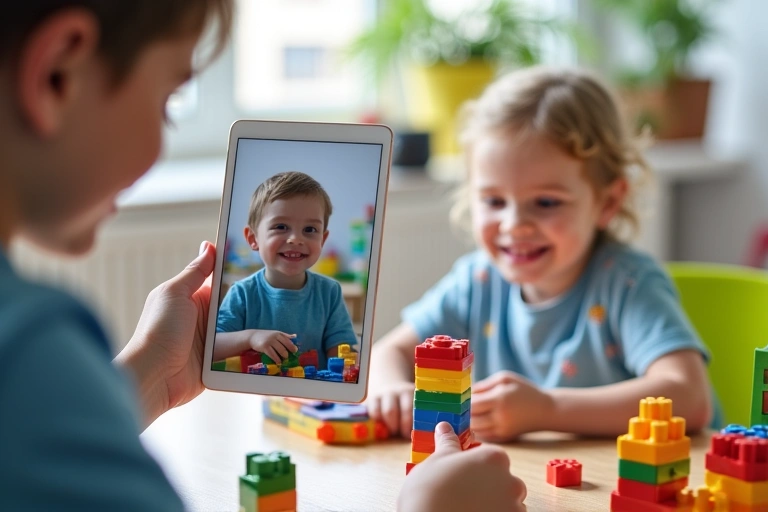
Imagine this: a child has a breakthrough moment, successfully navigating a tricky puzzle after days of trying. Instead of making a mental note to write down later, you reach for a tablet, capture a quick 10-second video of their triumphant smile, add a quick voice note linking it to a specific EYFS learning area, and share it securely with their parents—all in under a minute. This isn’t a futuristic dream; it’s the reality that modern school communication tools are bringing to EYFS settings today. The future of documentation is not about replacing the observation, but revolutionising how it's captured and shared.
By shifting to a digital platform, observations become dynamic and multi-faceted. Photos, videos, and audio clips can be instantly tagged to individual students and linked to specific EYFS outcomes. This creates a rich, searchable, and organised timeline of development that is far more powerful than a chronological scrapbook. Teachers can build a comprehensive picture of each child's progress without spending hours on paperwork after the children have gone home. It transforms documentation from a retrospective chore into a real-time, integrated part of the teaching process. This is the very essence of working smarter, not harder, and marks a pivotal step in the evolution of `edtech 2025`.
By capturing the process, not just the outcome, we gain a far deeper understanding of how a child learns.
This approach allows educators to capture the nuances of learning—the trial and error, the collaboration with peers, the moments of quiet concentration. A digital learning journey tells a much richer story, one that is alive with the authentic sounds and sights of the classroom. It provides a more holistic view for assessments and planning, helping teachers tailor their approach to each child's unique needs and interests with unparalleled precision.
Opening the Classroom Door: A New Era of Parent Engagement
One of the most profound benefits of digital EYFS documentation is the way it transforms parent engagement. The traditional end-of-term folder handover is replaced by a continuous, flowing conversation. When parents receive a notification showing a photo of their child mastering the monkey bars or a short video of them participating in story time, the barrier between home and school dissolves. They are no longer passive recipients of information but active participants in their child's daily learning journey. This proactive sharing fosters a powerful sense of partnership.
This level of involvement has a tangible impact. When parents see what their child is learning, they are better equipped to support that learning at home. Conversations at the dinner table can be sparked by a photo shared earlier that day. A parent might see their child is fascinated by building blocks and provide more opportunities for construction play at home. This creates a virtuous cycle where learning is reinforced across both environments, accelerating a child’s development and boosting their confidence. It makes parents feel valued and connected, which is the cornerstone of a strong school community.
Beyond Observations: An Integrated School Ecosystem
While digital observations are transformative, their true power is unlocked when they are part of a fully integrated school admin software. The future of EYFS management isn't just a standalone observation app; it's a centralised hub where every aspect of a child's day is connected. A platform like Parent Portal understands that learning doesn't happen in a vacuum. A positive observation in the morning might be linked to a reward point in the behaviour tracking system. A parent's notification of absence through the attendance module provides crucial context for the day. Important dates for 'Stay and Play' sessions or school trips are logged in the central calendar, with automatic reminders sent to parents.
An observation can be directly linked to a parent's evening booking, with AI-generated summaries helping to structure the conversation.
A payment for a school trip can be logged alongside the digital permission form, meaning no more chasing paper slips.
This integration saves hours of administrative time and reduces the risk of human error.
This holistic approach is designed to reduce teacher workload significantly. Instead of juggling multiple systems—one for communication, another for observations, a third for payments—everything is in one place. This creates seamless workflows and provides a 360-degree view of each student and the school community as a whole. For school leaders and admin staff, it offers invaluable oversight, making it easier to spot trends, manage resources, and ensure consistent communication across the entire school, from Nursery right through to Year 6.
Embracing the Future of Early Years Education
The transition to digital EYFS documentation is about so much more than just going paperless. It is a fundamental shift towards a more efficient, engaging, and insightful way of working. By embracing these tools, we empower teachers to reclaim their time and focus on what they do best: nurturing and educating young children. We provide parents with an unprecedented window into their child's world, fostering a partnership that has a lasting, positive impact on development. It makes the process of tracking progress against learning goals simpler, more accurate, and infinitely more meaningful.
Platforms like Parent Portal are at the forefront of this change, offering a comprehensive, user-friendly solution designed specifically for the needs of UK schools. By integrating observations, communication, behaviour, attendance, and more into a single platform, they provide the tools necessary to not only meet the demands of modern education but to exceed them. The future of EYFS documentation is here, and it's brighter, smarter, and more connected than ever before. It's time to put down the glue stick and pick up the tablet—your teachers, parents, and children will thank you for it.
Comments