
Recording Maths Observations: Capturing Problem-Solving in Action
Think back to your last maths lesson. What were the most significant moments of learning? Was it when a child correctly filled in a worksheet, or was it the flash of understanding in their eyes as they finally grasped a tricky concept? Was it the neat column of sums, or the messy, collaborative process of two children debating how to fairly share a pile of counters? For many teachers, the most profound learning happens in these fleeting, unscripted moments of discovery, reasoning, and problem-solving. The challenge has always been how to capture, assess, and share this “maths in action” without adding to an already overwhelming workload.
Mathematics in the early years and Key Stage 1 is not just about numbers and calculations; it's a dynamic language of logic, pattern, and spatial awareness. It’s about building resilience, testing theories, and learning from mistakes. Capturing this rich tapestry of skills requires us to look beyond the final answer and focus on the journey. Fortunately, the evolution of smart school communication tools is transforming our ability to do just that, turning transient moments into tangible evidence of progress.
Moving Beyond the Tick Sheet
For decades, maths assessment has been dominated by paper-based evidence. Worksheets, workbooks, and tests serve a purpose, but they often tell an incomplete story. A page of correct answers might show that a child has memorised a method, but it reveals very little about their depth of understanding. It doesn’t tell you how they arrived at the answer, whether they could apply the same logic to a different problem, or how they explained their thinking to a peer. Conversely, a page of errors tells you what a child can’t do, but gives few clues as to where their misconception lies.
This reliance on static evidence often forces a narrow view of mathematical ability, creating pressure on both students and teachers to focus on performance over process. It also adds a significant administrative burden, with teachers spending hours marking books and transferring data to tracking systems. This approach risks missing the very essence of mathematical development: the critical thinking, communication, and creative problem-solving skills that are foundational for future success. We need a method of assessment that is as dynamic and multifaceted as the learning itself.
What Does "Maths in Action" Really Look Like?
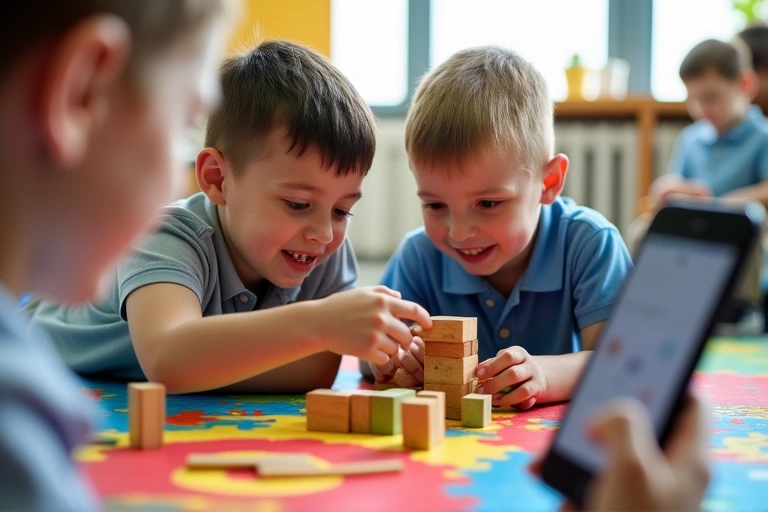
When we shift our focus from product to process, we begin to see mathematical behaviour everywhere. It’s in the nursery garden, as children estimate how many watering cans it will take to fill a bucket. It’s at the construction area, where they use positional language like “behind,” “next to,” and “on top of” while building a tower. It’s in a heated debate between Year 2 pupils about the most efficient way to count a large set of objects—by twos, fives, or tens?
These are the golden nuggets of learning. They demonstrate a child’s ability to hypothesise, experiment, and articulate their reasoning. They show us their developing number sense, their spatial awareness, and their ability to collaborate and persevere. These are the skills that tick sheets simply cannot capture. By tuning our professional focus to these moments, we gain a far deeper and more authentic understanding of each child's mathematical mind.
The real magic of mathematics lies not in the final answer, but in the journey of discovery, the collaborative debate, and the quiet resilience of a mind at work.
Observing these behaviours provides invaluable formative assessment data. It allows teachers to identify misconceptions in the moment, to pose extending questions, and to understand the unique strategies each child employs. The challenge isn't seeing these moments; it's recording them in a way that is quick, efficient, and meaningful, without disrupting the natural flow of learning.
Making Observations Manageable and Meaningful
Herein lies the classic teacher's dilemma: you witness a fantastic moment of mathematical reasoning, but by the time you find a pen and a sticky note, the moment has passed, and your brief scribble hardly does it justice. This is where technology can become a teacher’s most powerful ally. Modern platforms like Parent Portal are designed to make capturing rich, in-the-moment observations effortless.
Imagine a child in your EYFS setting using blocks to explore number bonds to 10. They are talking to themselves, saying, “If I have six here, I need… one, two, three, four more to make a whole ten!” Instead of scrambling for a notepad, you simply tap a button on your tablet and record a 30-second voice note. You’ve captured their exact words, their tone of concentration, and a quick verbal note for yourself about their confident use of one-to-one correspondence. Later, you can link this observation directly to specific Development Matters objectives.
Or perhaps you see a pair of KS1 children who have created an intricate, symmetrical pattern with coloured tiles. A quick photo or short video observation captures their work perfectly. You can tag both children, add a caption noting their use of mathematical language around symmetry and rotation, and share it directly to their learning profiles. This isn't just about collecting evidence; it's about building a rich, longitudinal picture of each child's development, composed of authentic moments of learning.
Using Technology to Work Smarter, Not Harder
The idea of recording more observations might sound like creating more work, but with the right school admin software, the opposite is true. The goal of powerful edtech in 2025 and beyond is not to add tasks, but to streamline them, freeing up teachers to do what they do best: teach. The key is automation and artificial intelligence, which can handle the heavy lifting of organisation and analysis.
For instance, those voice notes you recorded are automatically transcribed by AI. No more typing up handwritten notes at the end of a long day. The accumulated data from hundreds of these micro-observations can be analysed by AI-powered progress analysis tools. The system can identify patterns, highlighting a child's strengths in spatial reasoning or flagging a recurring difficulty with partitioning numbers. This provides teachers with actionable insights for planning next steps and differentiation, effectively acting as an expert teaching assistant.
This intelligent use of technology directly addresses the challenge to reduce teacher workload. When it comes to writing end-of-term reports, the AI Report Writing Assistant can draw upon the entire bank of recorded observations—the voice notes, the photos, the curriculum links—to generate unique, evidence-based comments for each child. The result is a highly personalised and accurate report, written in a fraction of the time, reflecting the child’s genuine learning journey.
Sharing the "Why" Behind the Maths with Parents
One of the most transformative aspects of recording “maths in action” is the opportunity it creates for parent engagement. For many parents, their understanding of school maths is limited to the worksheets their child brings home. This can create anxiety, especially if their own experiences with maths were negative. Sharing observational moments changes the entire conversation.
When a parent receives a short video of their child confidently explaining how they solved a problem, or a photo of their collaborative building project, they see their child as a capable, curious mathematician. It shifts the focus from “Did they get the right answer?” to “Look at how they thought that through!” This is a powerful way to foster a positive maths mindset at home and build parents' confidence in the school's approach. Effective school communication tools bridge the gap between classroom activity and home conversation.
- Sarah, Year 2 Teacher
By using an integrated platform, these snippets of learning can be shared securely and instantly. Parents see a timeline of their child's progress through the student learning profile, building a holistic view of their journey. This continuous, positive communication strengthens the home-school relationship and creates a community of adults all working together to celebrate and support the child’s development.
Building a Richer Picture of Mathematical Development
By moving beyond the limitations of traditional assessment, we can honour the complexity and creativity inherent in mathematics. Capturing problem-solving in action allows us to see our students not just as learners of facts, but as thinkers, communicators, and collaborators. It provides us with the authentic assessment data we need to tailor our teaching, support every child, and truly understand their progress.
Embracing modern school communication tools and AI-powered observation features isn't about replacing good teaching with technology. It's about augmenting it. It’s about making it feasible to capture the moments that matter most, using that evidence to reduce workload, and sharing the story of learning with the parents who are our most important partners. By doing so, we don't just track progress; we celebrate the vibrant, messy, and wonderful process of mathematical thinking itself.
Comments